Monday, 5 October 2009

Throwing Light on Garden Design

Many enthusiastic people put a lot of effort into planning their gardens, making sure that it suits their daytime needs, but often, in my experience, completely overlook extending the use of the garden into night time. Having invested money in making a garden such a splendid leisure space, why not make it usable for longer? Not only can a good lighting design offer greater flexibility in garden use during summer months, but it can also provide a magical nightscape as seen from the house or conservatory, adding drama and atmosphere to the whole scene all year round.
There are 4 main uses of outside lighting – functional lighting is used to illuminate areas such as dining and entertaining spaces on patios or terraces, or for leisure areas such as pools, hot tubs, spaces for sitting and relaxing with a book, etc; safety lighting is used to mark paths, steps, archways, walls or other obstacles, edges of pools, trip hazards and so on; security lighting would normally be used in conjunction with motion sensors to floodlight areas such as drives and sides/back of properties and outbuildings, and might also be linked in with CCTV recording, or with automatic gate or garage door systems; decorative lighting is used for creating the nightscape scenes by “painting” light onto trees, plants and hard landscape features - using light and shade, shadows, halos, silhouettes, textures, and, perhaps, colours, to transform the garden views into something which could not be achieved in daylight.
Various types of lights - more correctly called luminaires (technically lamp is the bit which gives out light, i.e. what’s loosely called a “bulb”) - can be used for these different purposes. Some are fixed onto walls or other structures, or even attached to trees; some can be set into a lawn, patio or deck; others are free-standing such as bollards alongside a drive, or as pole or spike spotlights used within planting. There are a wealth of styles for the luminaires, from traditional “coach lamp” and lantern styles through to uber-modern chic; they come in finishes of stainless, copper, brass, or colours like black and green. The lamps used can either be mains voltage or low voltage - using weather-proof transformers located near to the string of luminaires to step down the mains to a level (typically 12v or 24v) which is safe even if you accidentally chop through a cable whilst gardening. They will usually be one of 3 types depending on their purpose – most commonly tungsten-halogen (similar to those used in kitchen ceiling downlights) which offer a very wide range of light output (wattage) and beam spread, and can also be faded up & down with suitable equipment. The second type, LED lamps, are highly efficient and stay cool, so they are especially useful in situations such as deck lights or other places where accidental contact with people or animals is a possibility; they also have a very long lifetime and can give out blue, amber, red & green light as well as white light - devices are available to mix the light colours to provide an infinitely variable range of hues which can even be changed to match the mood or occasion, or can be programmed to create varying colour light shows for parties. The third main type is metal-halide lamps which give out high-powered, intense light used for the uplighting of large trees or faces of buildings.
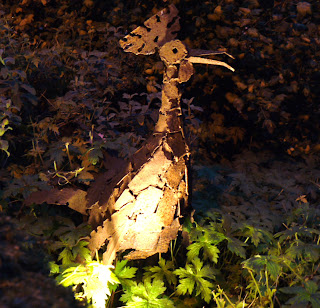
As an aside, the cheap, solar-powered devices now widely available from garden centres, DIY stores and the like are not really viable for effective garden lighting. While the glow they emit (usually low-powered LEDs) means they themselves can be seen over a relatively short range, they do not have the power to illuminate other objects (e.g. plants, steps, etc. as described above), nor to be seen from any distance. They may just about provide “way-marking” along the sides of paths or “twinkle” lights around a small, otherwise dark, feature which is close to the viewing position. Remember too, if you use these, that they must be in a reasonably sunny area in daytime to charge them up – so no use trying to illuminate a path shaded by trees!

Unless you’re using the units to make a “design statement” (e.g. modern stainless steel on a chic terrace), the aim of a well-designed system is to see the lightscape – the results of lighting featured objects - not to see the lights themselves. Carefully considered lighting achieves this without causing “light pollution” to annoy neighbours or glare to make the scene uncomfortable.
As well as basic on/off switching, modern professional lighting systems can be designed to control all of the system, or specific parts of the system, from a portable, wireless remote control unit, with different zones allowing for multiple options of switching and dimming.
By defining which areas of the garden need lighting - deciding on the type of lighting to enhance each feature, and where lights will be placed for maximum effect - a professional lighting plan will provide a scheme to serve all needs, whether safety, security, functionality or decoration. Ideally, this will be undertaken as part of the overall garden design such that the best synergy is achieved and the practicalities of installing the lighting can be done at the same time as other disruptive hard landscaping work, saving costs against grafting on a lighting design once the “daytime” project has already been completed.
If you would like a free consultation to discuss professional outside lighting, whether as part of a new design scheme or for an existing garden, please contact me via my website.
If you fancy doing a bit of research yourself, there's an online catalogue of lighting components here, along with design advice and hints & tips.

Finally, remember that (in the UK) it is a legal requirement for outside electrical work to be carried out by a competent, “Part-P” qualified electrician. Always ask for the Part-P certificate on completion of the works – without this you may encounter difficulties if you subsequently come to sell your property.

Sunday, 27 September 2009

Japanese Knotweed - set a thief to catch a thief?


We can give great thanks to the Victorian era “plant hunters” who brought back many of the exotic species which we now take for granted as part of the colour and structure of our gardens - but we can also curse them for some of their introductions – notably Rhododendron ponticum and especially Fallopia japonica (“Japanese Knotweed”).
What’s the problem?
Japanese knotweed is native to Japan, China and Korea, where it is part of the natural ecology with its own controlling pests, and was brought here around 1825 for decorative effect. Lacking any ecological balances here, it has been so successful that it is now widespread throughout the UK (with the exception of the Orkneys) and threatens the indiginous plants in large parts of Wales and South-West England. In addition to its effects on flora, and the implications this has for bio-diversity and food chains, it has adverse impact on riverbanks, leading to erosion and increasing flood risks, and on fish stocks within rivers; it can damage asphalt surfaces, building foundations, retaining walls and drains; it can create safety issues by obscuring railway signals and road signs and create trip hazards in paving.
For these reasons it was made illegal to plant, propagate or otherwise spread it in the UK by the Wildlife and Countryside Act 1981. It is also classed as "controlled waste" in Britain under the Environmental Protection Act 1990, so it may not be disposed of along with other “green” or household waste. This also applies to any soil contaminated with parts of the plant – adding extra costs to development and regeneration schemes. To give a sense of scale to the problem a DEFRA review in 2004 gave an estimate of £1.5bn for the cost of eradicating it – mainly with chemical herbicides, which are themselves considered “unsustainable”. In addition to our problems it is classified as a highly invasive weed throughout Europe and the USA and is listed as one of the 100 worst invasive species by the World Conservation Union.
How can it be recognised?
Recognition is fairly easy – it has hollow purple-speckled stems with raised nodes which look similar to bamboo canes and which carry broadly-oval grass-green leaves about 8-12cm (3-5”) long by 5-10cm (2-4”) wide alternately along the zig-zag stems. The leaves have a smooth (“entire”) edge and a “cut-off” base. Spikes (“racemes”) of creamy-white flowers, about 5-15cm (2-6”) are produced in late summer – these are initially erect, but tend to droop as they fade; they are not (yet!) fertile in the UK so the plant does not spread by seeding. The hollow stems become brown and brittle but remain after the rest of the plant dies back in late autumn.
It spreads by rhizomes, which can reach 7m in length and 3m deep, to form dense colonies that crowd out other herbaceous species. It is often found on roadsides and wasteland where it can be extremely difficult for site developers as the depth and spread of rhizomes make it virtually impossible to excavate and it re-grows strongly from any remaining pieces or after being cut down. Any plant material, or contaminated soil, must be disposed to properly licensed landfills.
How can it be controlled?
Currently the most effective control is through (repeated) treatments of translocated (“systemic”) Glyphosate-based herbicide. This is a non-specific product and will therefore kill any actively growing plants which absorb the spray through their leaves - so if the stand of Japanese knotweed is within other desirable plantings (as in the photos) it will be very difficult to remove. In a domestic situation, some success may be had through the use of a glyphosate gel, painted directly onto the knotweed leaves, covering as much of the plant as possible whilst avoiding contact with other plants – though this will be an extremely time consuming “labour of love”.
Biological Control
There is some hope now that biological controls might prove effective, of which there are 2 promising candidates – a leaf spot fungus, Mycosphaerella polygoni-cuspidati, and a sap-sucking insect, Aphalara itadori. The latter is a naturally occurring control in eastern Asia, but is not currently found in Europe, and is therefore prohibited under the same act which bans spread of the knotweed plant, i.e. The Wildlife and Countryside Act 1981, and is also restricted under the Plant Health Order 2005. DEFRA and the Welsh Assembly Government are currently asking for views from people/organisations with an interest in the impact of Japanese knotweed on the natural and built environment - including the horticulture industry, landscape managers/contractors and people interested in the control of invasive species - on the release of this insect as a control agent. If approved, this would be the first use of a non-native insect to control a plant species in the UK and Europe. The consultation input is required by end of October – further information on this can be found at http://www.defra.gov.uk/corporate/consult/japanese-knotweed/index.htm and at http://www.cabi.org/japaneseknotweedalliance
General information about Japanese Knotweed can also be found at http://en.wikipedia.org/wiki/Fallopia_japonica and at Devon’s excellent site http://www.devon.gov.uk/japanese_knotweed.htm

Monday, 21 September 2009

Save the Bees!

Going back to a topic from a little while ago on (not) tidying up the garden, the encouragement of bees is a good reason not to have your garden too neat. Even if you don’t like honey, remember that it’s the pollinating work of bees which provides us humans with at least one third of the food we eat. The Global Bee Project campaigns for the survival of bees of all sorts which are so important for plant pollination worldwide. They ask us to leave some wilder places in our gardens to provide refuge for bees and other insects. We may think mainly about honeybees, but bumblebees are in danger too, through loss of habitat. The Bumblebee Conservation Trust urge us to grow traditional cottage garden plants, and give a table showing which plants we should be growing in each month to help the bumblebees. The RHS also gives details of plants which will attract bees My own garden seemed to be full of bees this year, so I hope maybe I’m doing my bit. As well as the structural plants I included in my new design, I also sowed packets of colour-themed annual seeds, which produced many flowers attractive to bees and butterflies.

Tuesday, 15 September 2009

American Public Landscapes

If you’re a fan of parks and gardens and planning a visit to Chicago, USA, or for anyone interested in American landscape architecture, I've just come across a great website which is the “legacy project” about Jens Jensen (1860-1951) who helped create the “Prairie” style of municipal parks and private gardens in the early 20th century. The site has biography, drawings and photos, plus links to other sites, describing several of his related works and other online newsletters for further research.
I found this site from a reference on Jane Berger’s excellent blog “Garden Design Online”, which has articles covering American gardens, events, books, magazines etc.

Thursday, 10 September 2009

Growing Veggies in Window Boxes

An interesting campaign by the National Trust is to persuade people to turn their window ledges into veggie gardens. They estimate there are more than 600 acres of growing space on window sills all over the UK. They suggest growing things like lettuce, radishes, beetroot, chard and herbs in window boxes that get good sunshine. An article in The Telegraph about the initiative mentions Kingston Lacy as one NT property where they’ve installed window boxes, and says that other properties have converted hanging baskets for vegetable growing. The National Trust has already given up land for allotments over the country.

Sunday, 6 September 2009

Blooming Good Gardens at the Local Fete


Great fun yesterday, when the village held its very first fete in the park at the end of our road. I had a stall there, offering free garden design advice, and the whole day was really enjoyable. We were in the park by 8 am, organising the stall, and there was a real neighbourly buzz as everyone mucked in together to get things ready. I'd just struggled for nearly an hour to put up the gazebo, when I was told that someone hadn't turned up, and I could move to a better pitch, so three other guys helped me "walk" the whole structure to the other end of the ground. I think it was a worthwhile day, business-wise, mainly through the local contacts I made, but it was also worth the charitable donation required for having the stall, because it was just plain nice to see the neighbourhood enjoying having fun together, for such a good cause. There was a good crowd, right from the start, and we had a lot of people being complimentary about our new front garden. A bonus was that the weather was pretty good, too. Let's hope it becomes a regular occurrence.

Wednesday, 2 September 2009

(not)Tidying the Garden for Winter

Many people find their gardens can be a bit “flat” at this time of year after the fireworks of summer, though regular dead-heading will prolong the season for many flowers and there are some good-value plants which will continue well into autumn – Anemone hybrids (“Japanese Anemones”), Rudbeckia & Echinacea (“Cone Flowers”), Asters and, of course, Sedums (“Ice Plants”) which are only just coming into flower – as are the late-flowering ornamental grasses such as Miscanthus.
As we move into autumn, lots of people start to tidy everything up in the garden for winter, but I think there is good reason not to go too mad. Wildlife can find shelter in a little overgrown patch which is hidden away alongside a shed or tucked behind a hedge. I like to leave seed heads on plants too, instead of cutting them down too early. They attract birds, and look really lovely when they’re frosted – sedum, achillea and echinops are good examples, as well as most of the small ornamental grasses. I also love to see shrubs draped with spider’s webs, where moisture droplets have gathered. Leaves should be raked off lawns, where they would cause damage, but piles of leaves can be welcome shelters for hedgehogs and other small mammals and insects. So for me, late winter/early spring is the time to cut everything down. I like my winter garden to provide interest for me and its other inhabitants.